


Table of contents
The inspection call comes. Within hours, a CQC inspector will arrive at your agency. The first thing they'll ask, before they speak to a single carer or client, is to see your records.
Which records, exactly? In what format? And how quickly can you pull them together? These are the questions that keep registered managers awake the night before an inspection. This post answers them specifically for domiciliary care agencies, and explains why the quality of your evidence (not just its existence) is increasingly what determines a rating.
Why CQC increasingly expects digital evidence
The CQC's approach to evidence has shifted significantly in recent years. Under the Single Assessment Framework, and continuing with any new framework coming in 2026, evidence is gathered continuously rather than only during a formal visit. This means the quality and currency of your records matters all the time, not only in the weeks before an inspection.
The CQC now places growing weight on real-time, auditable documentation. An inspector looking at a care record wants to see when it was completed, by whom, when changes were made, and whether it accurately reflects what was happening at the time. Timestamped, system-generated records carry evidential weight that handwritten or retrospectively filled records simply cannot match.
The government's programme to support the adoption of Digital Social Care Records (DSCRs) across social care providers reflects the same direction of travel. For home care agencies still using paper or hybrid systems, the gap between what CQC expects and what you can realistically produce is growing.
Records inspectors request in a home care inspection
The following records are commonly requested or reviewed during a home care inspection. Some may be requested in advance through the CQC provider portal; others will be reviewed during the visit itself.
Daily care notes and visit records. A complete account of what happened during each visit: tasks completed, observations made, any concerns noted. Inspectors look for notes that are specific and contemporaneous, not generic or clearly completed after the visit.
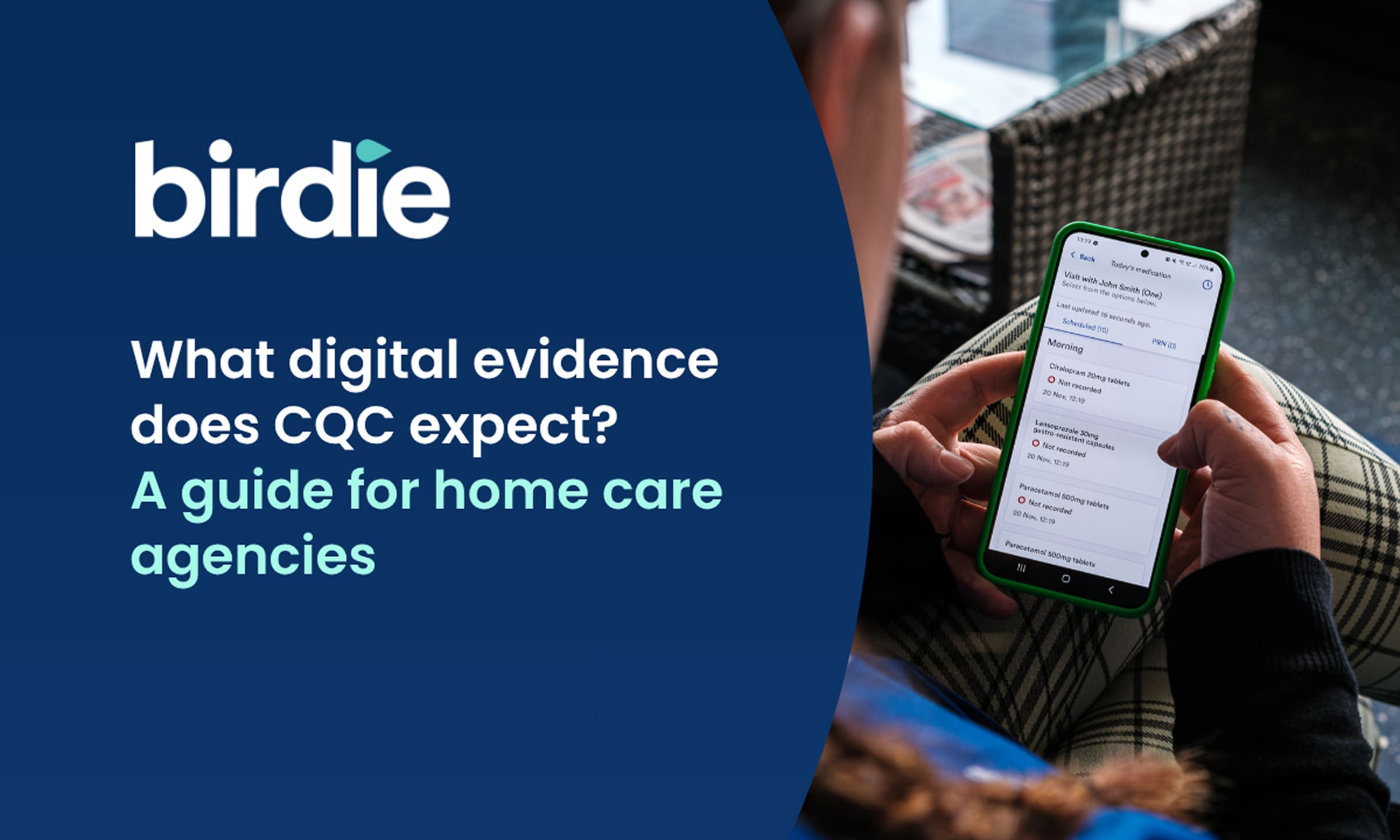
Medication administration records (MARs). A full record of every medication task, including the medication name, dose, time, who administered it, and the outcome. Gaps in MARs are among the most commonly cited findings in home care inspections. Records should be completed at the time of each visit.
Risk assessments and care plans. These must be current, person-centred, and reflective of the individual's actual needs - not a generic template. Inspectors look for evidence that care plans are reviewed regularly and updated when needs change.
Incident and accident reports. Every incident and near-miss should be logged, with details of what happened, who was involved, what action was taken, and what learning followed. A well-maintained incident log demonstrates a culture of openness and continuous improvement.
Supervision and appraisal records. Evidence that each member of staff receives regular one-to-one supervision, with notes, and an annual appraisal with recorded goals and feedback. Gaps in supervision records are frequently noted under the Safe and Well-led domains.
Staff training and DBS records. A complete record of mandatory and role-specific training for every member of staff, with completion dates and renewal schedules. DBS check dates, levels and renewal status for every member of the team.
Complaint logs and outcomes. A written record of every complaint received, how it was acknowledged, how it was investigated, the outcome communicated to the complainant, and any resulting changes to practice. If you're unsure how to structure those records or what the investigation process should look like, our guide to home care complaints procedure and record-keeping covers the requirements under Regulation 16.
Carer observations and wellbeing checks. Evidence that the agency monitors the quality of care being delivered in the home: spot checks, quality visits, feedback from clients and families. This is particularly important for the Caring and Effective domains.
Paper vs. digital evidence
Paper records can meet a basic legal requirement. But from an inspection perspective, they'll always create risk that digital records do not.
A handwritten care note has no audit trail. It cannot confirm when it was written, whether it was written at the time of the visit, or whether it was altered afterwards. An inspector who asks to see a week of medication records for a client with complex needs will typically receive a folder. The time it takes to locate, sort and present that folder is time spent under scrutiny.
Digital records, by contrast, are timestamped at the point of entry. They record who completed each task, at what time, with what outcome. They can be pulled in seconds by client, carer, date range, or task type. They produce patterns (such as trends in missed visits, late medications, repeated incidents) that paper systems do not surface until it is too late.
This is not about whether digital records are "better" in an abstract sense. It's about what an inspector can verify, how quickly, and with what confidence. An agency that can produce a clear, auditable, timestamped record of its care delivery is in a fundamentally different position from one that cannot.
What "real-time" documentation means in practice
Real-time documentation means records are completed during the visit, not afterwards. For a carer using a digital app, this means logging each task as it is completed: recording whether a medication was given, noting that a client seemed in pain, flagging that the client's daughter asked a question about the care plan. All of this is timestamped at the moment of entry.
The significance of this for CQC is straightforward: a record completed at 09:47 during a visit is evidence. A record completed at 18:00 when the carer returns home is a reconstruction. An inspector who sees dozens of care notes all completed late in the evening, or all completed at the same time, will draw conclusions from that pattern.
Real-time records also protect the carer and the agency. When something goes wrong - a client falls, a medication is missed, a concern is raised - a complete, timestamped record of what happened during that visit is the clearest possible account of the facts.
Questions to ask your current system
Before your next inspection, run through these questions about your current documentation tools:
- Can it export care records organised by CQC domain, key question, or individual care worker?
- Can it show patterns and trends across visits, such as missed tasks, late completions or repeated incidents?
- Are all records timestamped automatically at the point of entry?
- Is there a complete audit trail showing who made each entry and when?
- Can you pull a full report for a specific client, carer or time period in under five minutes?
- Is the system accessible to a CQC inspector during a visit, without needing specialist IT support?
- Can it produce a Provider Information Return (PIR) data summary directly from the records held?
If any of these answers is no or "it depends", that is a gap worth addressing before an inspection, not after. For a broader view of what good evidence looks like across all five CQC domains, see our guides to CQC key lines of enquiry, the CQC fundamental standards, the CQC Single Assessment Framework, and our complete CQC compliance guide for home care agencies.
Birdie is built so home care agencies are inspection-ready every day, not just when the call comes. Real-time care notes, electronic medication administration records, timestamped incident reports, and analytics that surface patterns across your whole service — all in one platform, built specifically for domiciliary care. 76% of Birdie partners say they can better evidence the quality of care to CQC. Book a demo to see how it works.
Published date:
April 27, 2026

Author:
Lucy Ogilvie



%20(1)%20(1).jpg)

.jpg)

%20(1)%20(1).jpg)


.svg)